

Motor vehicle pollution
What is motor vehicle pollution?
All motor vehicles release pollutants into the air, mostly through the exhaust fumes that come out of the tailpipe when the engine operates.
Did you know that:
- more than 99.4% of all pollutant gases are invisible
- your car releases emissions even when it's standing still
- other fumes from petrol and lubricants evaporate into the air.
Pollutants produced by vehicle exhausts include carbon monoxide, hydrocarbons, nitrogen oxides, particles, volatile organic compounds and sulfur dioxide. Hydrocarbons and nitrogen oxides react with sunlight and warm temperatures to form ground-level ozone. Ground-level ozone, a main ingredient in smog, can cause upper respiratory problems and lung damage.
How big is the problem?
Research shows that motor vehicles are responsible for about 70% of south-east Queensland's air pollution. Unless we all start reducing car use and motor vehicle pollution, this level is set to increase dramatically.
Independent research conducted by the Department of Transport and Main Roads identified air quality as a major concern among people in south-east Queensland. An average car creates almost 6 tonnes of pollutants each year. That's approximately equivalent to the weight of 7 small cars.
Despite this, current air quality is relatively good—but that doesn't mean it will remain that way in the future.
South-east Queensland's population is predicted to reach 3 million in the next 15 years. If car use continues to rise, researchers predict we will double the number of vehicle kilometres travelled over the same period.
Releasing some emissions (and causing some air pollution) is an unavoidable by-product of using a motor vehicle. But there are simple steps you can take to make sure your vehicle's emission levels are as low as possible. To find out more, read how you can help reduce your car's emissions.
How can the problem be fixed?
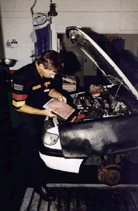 According to the Federal Office of Road Safety's National In-Service Vehicle Emissions Study, if all vehicles were tuned correctly there would be up to:
- 16% less tailpipe hydrocarbon emissions
- 26% less tailpipe carbon monoxide emissions
- 9% less nitrogen oxides emissions.
- replacing points and air filter
- replacing fuel filter
- replacing oil and oil filter
- checking spark plug condition and gap—adjusting or replacing
- checking distributor condition and operation and adjusting
- checking and adjusting idle mix and speed
- checking and replacing spark plug and distributor leads
- checking and replacing hoses and other minor items in fuel/electrical/emission control system
- examining vehicle diagnostics and replacing faulty components.
- Last updated 24 August 2017