


Sharing the road with heavy vehicles
Keep safe and reduce your risk of a crash by knowing about the different types and sizes of heavy vehicles. These include:
- rigid truck
- semi-trailer trucks—mainly used in urban areas because of their smaller size
- road trains—longer vehicles which vary in size, including double, triple, and quad road trains
- buses
- grain transporters
- livestock transporters
- tanker trucks
- cement trucks
- tractors.
Driving safely near heavy vehicles
Heavy vehicles can't speed up or slow down as quickly as lighter vehicles, like cars. They also need more space to make turns and have much larger blind spots than cars. When driving near heavy vehicles, keep in mind the following tips.
1. Stay out of heavy vehicle blind spots
Blind spots are positions around a heavy vehicle where your vehicle may not be visible to the driver of the heavy vehicle. For a truck, these blind spot areas are shown in yellow on the diagram below, and are:
- immediately in front of the truck
- beside the truck driver’s door
- on the passenger side which runs the length of the truck and extends out three lanes
- directly behind the truck.
Similar blind spot areas also apply to other heavy vehicles such as buses.
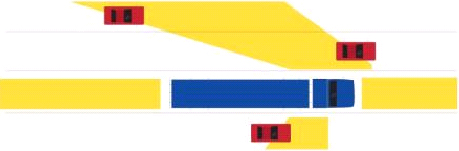
If you can't see the truck driver’s mirror, the truck driver can't see you.
Blind spot detection technology
We're helping heavy vehicle drivers and owners implement technology to improve road safety, including:
- Blind Spot Information Systems—alert heavy vehicle drivers that vehicles or other vulnerable road users, such as cyclists, are in their blind spot
- Indirect Vision Devices, cameras and other technology—installed to observe the traffic area near the vehicle which cannot be seen by direct vision.
2. Follow at a safe stopping distance
Don't follow a heavy vehicle too closely as you need to see what's ahead, for example, debris and other cars. When travelling behind a heavy vehicle:
- allow time to stop safely. View our diagram on how long it takes to stop when driving the average car
- leave more than the recommended stopping distance when driving in weather that reduces your visibility, such as wind, rain or fog.
3. Look out for turning heavy vehicles
Heavy vehicles need more space when turning due to their size.
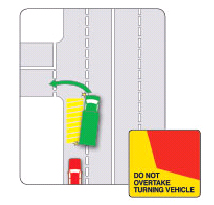
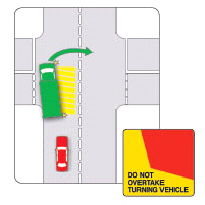
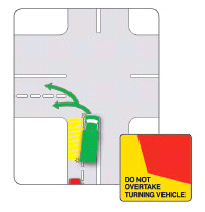
Heavy vehicles that have a DO NOT OVERTAKE TURNING VEHICLE sign are allowed to take up more than one lane to turn at corners, intersections and roundabouts. Be prepared to give extra space when you see a heavy vehicle's indicator flashing.
Read more about road rules in the Your Keys to Driving in Queensland handbook for all drivers. It contains essential information about the Queensland driver licensing system and road rules.
4. Overtake safely around heavy vehicles
- If travelling on the motorway or highway, try to use overtaking lanes whenever possible.
- On single lane roads only overtake when the road ahead is clear.
- Prepare for strong winds as you pass a heavy vehicle.
- When it's safe to overtake, first indicate, then speed up and overtake quickly, without going over the speed limit.
- After you overtake, maintain your speed so the heavy vehicle doesn't need to brake.
- Never overtake a heavy vehicle or long heavy vehicle on a curve or hill as you can't see far enough ahead.
Heavy vehicles are allowed to overtake your vehicle if you're travelling below the posted speed limit, and it's safe to do so. If a heavy vehicle approaches to overtake your vehicle, make sure you:
- maintain your speed and position until the heavy vehicle starts to overtake
- gently ease off your accelerator until the heavy vehicle has passed, if required, and then return to your safe travelling speed.
5. Approach and overtake road trains safely
Road trains can be up to 53.5m long, which is about 10 car lengths. Their trailers can sway from side-to-side as you pass, especially the last one. Share the road with road trains safely by following these simple rules:
- Expect road trains to stay on the bitumen when you overtake.
- When approaching an oncoming road train on a narrow road
- slow down
- pull on to the shoulder of the road
- stop, if necessary.
The size of a road train generates a lot of wind that can pick up debris from the road. Slowing down and pulling over may help prevent windscreen damage.
- Take notice of roadside conditions, for example, soft shoulders, guideposts and wildlife.