The simple truth about speeding is: the faster you go, the longer it takes to stop and, if you crash, the harder the impact. Even small increases in speed could have severe consequences. If a pedestrian steps out into the path of an oncoming vehicle which is speeding the difference could be a matter of life or death.
[Speaking - Professor Barry Watson Direct CARRS-Q, QUT]
The simple truth about speeding is that the faster you go the longer it takes to stop.
Here’s a comparison.
This is a car travelling at 60km/h and braking suddenly.
Here’s the same car, travelling at 67km/h and braking at the exact same point.
This time the car hits, still travelling at 30km/hr. The difference could be a matter of life or death.
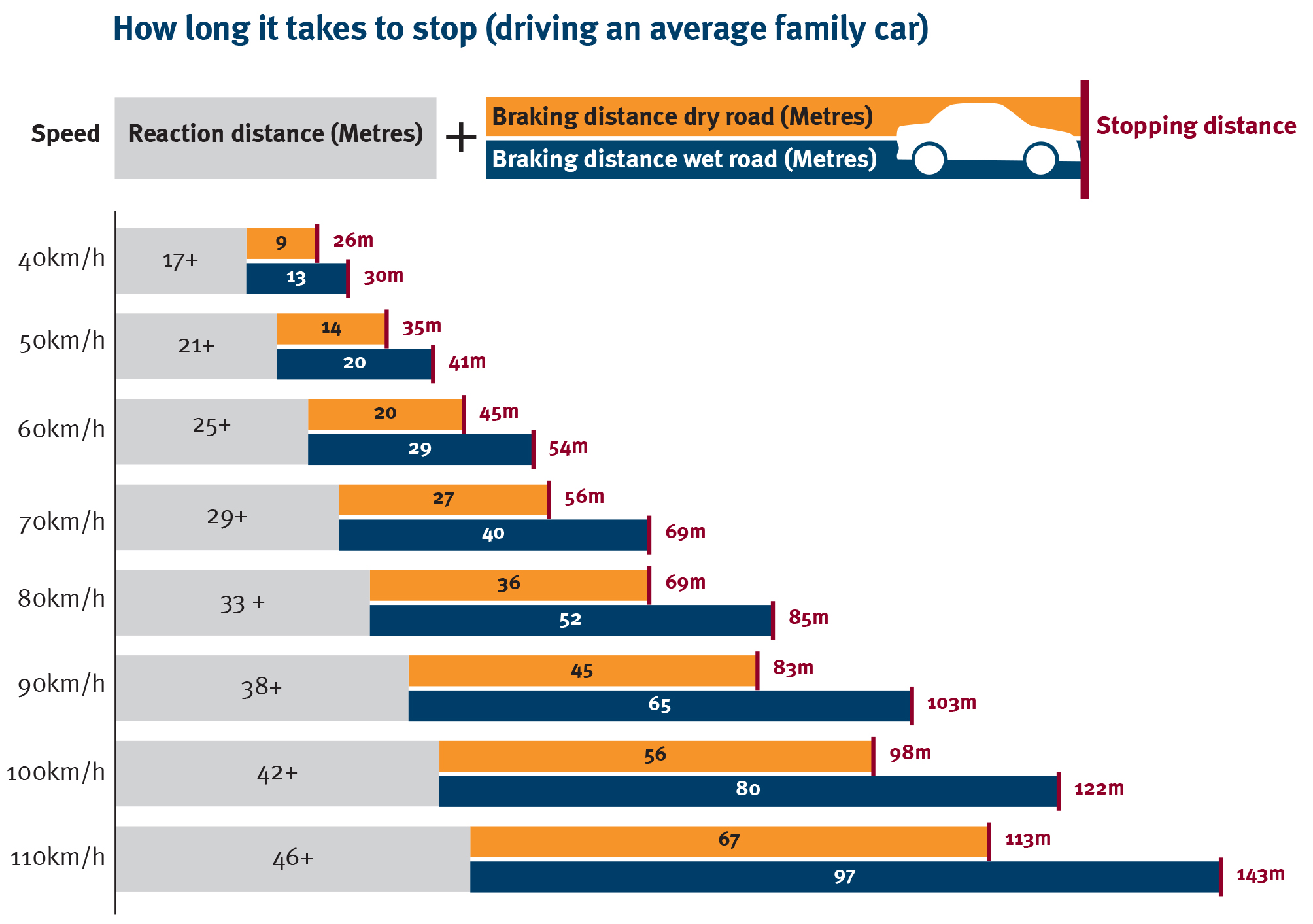
In an emergency, the average driver takes about 1.5 seconds to react. Stopping distances increase exponentially the faster you go.
The stopping distances on the infograph are calculated based on the following assumptions:
In an emergency the average driver takes approximately 1.5 seconds to react
A modern vehicle with good brakes and tyres, after braking, is capable of stopping at approximately 7 m/s2.
A dry road that is sealed and level enables good friction between the tyres and the road to help stop the vehicle sooner. Scientifically, it has a coefficient of friction of approximately 1.
A wet road that is sealed and level has less friction between the tyres and the road which increases the stopping distance of a vehicle. Scientifically, the coefficient of friction of approximately 0.7.
The stopping distances in the graph are generic and may be influenced by a number of driver, vehicle and environmental factors:
Driver factors
Vehicle factors
Environmental factors
Attention
Vehicle age
Road surface
Fatigue
Type and condition of brakes
Road gradient
Impairment due to alcohol and drugs
Type and condition of tyres, including tyre pressure
Road alignment
Vision issues
Safety features fitted to the vehicle for example ABS, ESC, EBA, etc.