

Tunnel safety
Tunnels make travel more convenient. However, you need to pay particular attention to safety when driving through a tunnel because of the enclosed road environment.
On this page:
- What are the main points to remember when travelling in a tunnel in Queensland?
- What should I do when entering a tunnel?
- What should I do if my vehicle breaks down or I crash in a tunnel?
- What should I do if I am caught in traffic while travelling in a tunnel?
- What should I do if there is a fire in the tunnel I am travelling in?
- Why are speed cameras located in tunnels?
- Offences for dangerous goods in tunnels
- Tunnel safety features of CLEM7, AirportlinkM7 and Legacy Way
What are the main points to remember when travelling in a tunnel in Queensland?
When travelling in a tunnel:
- avoid changing lanes if possible (this improves safety for everybody in the tunnel)
- follow the directions displayed on signage and watch out for any changes in the speed limit
- always follow the speed limit and always obey the Queensland Road Rules—all speed limits in tunnels are enforced
- keep a safe distance from the car in front (at least a 2 second gap)
- try not to brake suddenly, especially in peak hour when traffic is heavier
- secure your load—penalties can apply for insecure loads in tunnels
- take extra care when merging in a tunnel
- move into your exit lane with plenty of time to spare.
You are prohibited from travelling in a tunnel if:
- you are running low on fuel
- you are carrying quantities of dangerous goods that require you to display placards in accordance with the Transport Operations (Road Use Management) Act 1995 and Transport Operations (Road Use Management – Dangerous Goods) Regulation 2008
- your vehicle or load height is above the tunnel height clearance limit
- you suspect your vehicle might break down
- you are carrying a load that is not secure
- the water deluge (fire sprinkler) system is activated.
What should I do when entering a tunnel?
When entering a tunnel:
- listen for updates or important traffic information on your radio
- turn on your headlights
- take your sunglasses off (unless prescription glasses are required)
- obey all traffic signs, signals and pavement markings
- avoid changing lanes if possible (this improves safety for everybody in the tunnel)
- keep a safe distance from the vehicle in front of you, even if traffic is slow.
What should I do if my vehicle breaks down or I crash in a tunnel?
If you break down or crash in a tunnel you should try to safely drive out of the tunnel if possible. If you're unable to safely exit the tunnel with your vehicle, you should:
- pull over to a safe place to stop, either at a breakdown bay or the side of the lane and out of the way of traffic
- switch on your hazard lights, stay calm and wait for an incident response unit to arrive
- remain in your vehicle or safely wait in front of your vehicle, unless there is a fire or you are told to evacuate
- call for help or use the nearest emergency phone to contact the tunnel's control room.
In the event of an evacuation, look for the running man symbols and flashing lights to locate a safe exit point.
What should I do if I am caught in traffic while travelling in a tunnel?
Follow these tips if you get caught in traffic whilst travelling in a tunnel:
- look for instructions displayed on overhead signs
- listen for updates or important traffic information on your radio
- ensure your windows are closed and switch your air-conditioning to re-circulate
- if you need urgent assistance, use the nearest emergency phone to contact the tunnel's control room (watch carefully for traffic while you get out of your vehicle).
What should I do if there is a fire in the tunnel I am travelling in?
Do not enter the tunnel if you see smoke ahead or have been warned there is a fire inside.
If you are in a tunnel and see smoke or fire ahead and have not received advice by radio or an electronic message board:
- pull over
- turn off your engine
- listen for updates or important traffic information on your radio
- await instructions via your radio, public address or incident response member.
If you are told to evacuate, leave your keys in the ignition in the 'off' position and follow instructions from the tunnel's control room or incident response crew about exit points.
If your vehicle catches fire, pull over to the left side of the road and stop the car. Turn off the engine, get out of your car and be careful of passing traffic. If it is an engine fire, do not open the bonnet as oxygen will fuel the fire. If a fire extinguisher is nearby, release the catch on your bonnet but do not open the bonnet. Direct the fire extinguisher onto the fire through the gap. An incident response unit will arrive as soon as possible.
If you can't put out a vehicle fire, leave your keys in the ignition and use either an emergency phone or a mobile phone to call 000. Follow any instructions given to you.
Why are speed cameras located in tunnels?
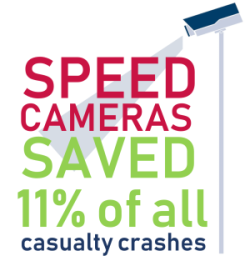
Fixed speed cameras are installed on roads that have a crash history or a potential risk of speed related crashes. The nature of tunnels makes speeding through them particularly risky. Speed cameras in tunnels encourage everyone to drive within the speed limit, which reduces the risk of crashing.
The most common hazard in a tunnel is a vehicle breakdown or crash that may cause a fire or result in serious injury. Speeding reduces your reaction time if one of these hazards appears unexpectedly, making it more likely a crash will occur.
Crashes in tunnels can prove extremely costly in terms of human life, increased congestion, pollution and repair costs. Tunnels can also complicate the rescue efforts of emergency services personnel.
Speed cameras are operated by the Queensland Police Service.
Offences for dangerous goods in tunnels
 It is an offence to carry a placard load of dangerous goods in a tunnel where there is a placard load prohibited sign (see image).
In addition, where the transport of a placard load of dangerous goods through a tunnel causes harm to a person, place or environment, the penalties are greater and can include imprisonment.
It is also an offence to display a placard when there is no placard load on board.
Get more information about dangerous goods in the AirportlinkM7, CLEM7 and Legacy Way tunnels.
Should you receive an infringement notice for driving a vehicle in a tunnel that prohibits placard loads, you may request a copy of the image taken by the tunnel camera system. To request a copy of the image that relates to the infringement notice you have received please e-mail [email protected]. Please include the infringement notice number in your email.
To understand the writing on the top of the image (known as the datablock) you will need to refer to the Automatic Number Plate Recognition (ANPR) Camera System Coding Manual.
Tunnel safety features of CLEM7, AirportlinkM7 and Legacy Way
- 24/7 visual surveillance of tunnel traffic by control room operators
- 24/7 incident response crew
- Automatic incident detection cameras
- Mobile phone reception
- Overhead water deluge (fire sprinkler) system
- Overhead smoke extraction system
- Emergency phones every 60m, approximately
- Fire extinguisher and hose reel cabinets every 60m, approximately
- Emergency exits with flashing strobe lights to point you to safe exits to use, approximately every 120m
- Public address and radio re-broadcast systems which are important for traffic updates in tunnels
- Variable speed limit signs
- Lane management signage:
- Red 'X' means lane closed
- Green '↑' means lane open
- Speed cameras, to encourage safe speeds and reduce the risk of road crashes in the tunnel.
- Last updated
- 4 February 2023