Give way means to slow down and, if necessary, stop in order to prevent a crash from happening.
You must always give way at a give way sign and check it's safe to continue. Give way signs are placed at intersections and other places where other vehicles have priority.
Remember, there are lots of situations on the road where you must give way even if there is no sign.
You need to give way if:
the rules say that you must
there's a give way or stop sign
there are stop or give way lines on the road
you're turning right across the path of an oncoming vehicle at an intersection
you're turning left or right at a T-intersection
you're moving onto a road from a driveway or land next to a road
you're moving off from being stopped on the side of the road
you're doing a U-turn
you're turning left at an intersection with a 'left turn on red after stopping' sign.
Video of giving way
Watch the video to learn more about giving way.
Is it true that you must give way to the right in all situations?
That's not always the rule.
At an unsigned crossroad, you must give way to all vehicles approaching from your right. But if you want to turn right, you must give way to all oncoming vehicles too.
If you're driving on a road that ends in a T-intersection, you must give way to all vehicles on the continuing road.
And naturally, if you come to a stop sign or a give way sign, you must give way to all other vehicles as well.
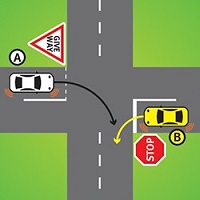
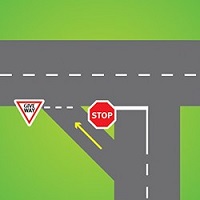
So what happens at an intersection with both a stop and a give way sign? Contrary to popular belief, a stop sign is not more powerful than a give way sign. The signs effectively cancel each other out and normal give way rules still apply. Both must give way to all vehicles, then because car A is turning right, it must give way to car B.
Finally, if you're planning to do a U-turn, you must give way to all other vehicles before turning.
Knowing the give way rules helps you drive safely and avoid crashes.
Intersections
An intersection is where 2 or more roads meet, and includes where a slip lane meets a road.
A T-intersection is where 2 roads meet (whether or not at right angles) and one of the roads ends.
Giving way at intersections with 2 stop signs or give way signs
Giving way when there is a stop sign and a give way sign
A stop sign is not more powerful than a give way sign when giving way. When 2 drivers arrive at stop or give ways signs at the same time, the stop sign becomes the equivalent of a give way sign. Both vehicles must give way to other vehicles before they must give way to each other.
In this example, 2 vehicles are opposite each other at an intersection. Vehicle A (in white) has a give way sign. Vehicle B (in yellow) has a stop sign.
Vehicle A (white) must give way to Vehicle B (yellow) because it is turning right across the path of Vehicle B (yellow).
Giving way at intersections with 1 stop or give way sign
Giving way at a give way sign to an oncoming vehicle that is not at a stop sign or give way sign
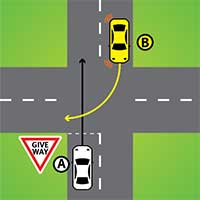
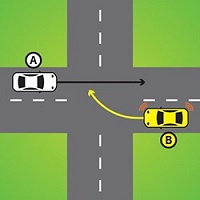
You need to give way if you face a give way sign or a stop sign or if there are stop or give way lines on the road, even if the other driver, who is not facing a stop or give way sign, is turning right across your path.
In this example, 2 vehicles are opposite each other at an intersection. Vehicle B (in yellow) is turning right across the path of vehicle A (in white) who has a give way sign.
Vehicle A (white) must give way to vehicle B (yellow) because vehicle A has a give way sign.
Giving way at uncontrolled crossroads
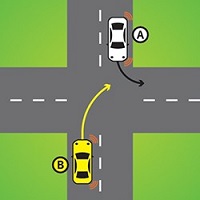
Giving way when turning at crossroads with no lights or signs
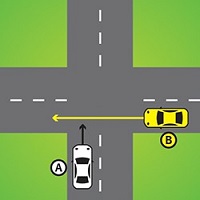
You must give way to vehicles on your right at an uncontrolled crossroad—this is a crossroad without any traffic lights, lines or signs.
In this example, Vehicle A (white) must give way to Vehicle B (yellow).
Giving way at a T-intersection
Giving way at a T-intersection
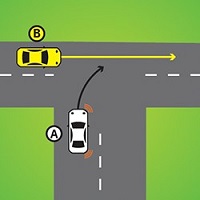
If you're driving on a road that ends at a T-intersection, you must give way to all vehicles—except those doing a U-turn—travelling on the road continuing through the intersection.
In this example, Vehicle A (white) must give way to Vehicle B (yellow).
Giving way when turning right
Giving way when turning right across the path of another car driving straight ahead
Giving way when turning right across the path of another car turning left
When turning right at an uncontrolled crossroad (without a slip lane), you must give way to vehicles coming from the opposite direction that are:
driving straight ahead through the intersection
turning left at the intersection.
In both examples, Vehicle B (yellow) must give way to Vehicle A (white).
Giving way when using slip lanes
Giving way on a slip lane
A slip lane is an area of road for vehicles turning left that is separated from other parts of the road by a painted island or traffic island.
If you're using a slip lane, you must give way to all traffic already on the road you're entering (except vehicles doing a U-turn).
Giving way to buses
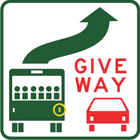
Give way to buses sign
A bus is a vehicle that can carry 13 or more people (including the driver).
When you are driving in a built-up area and the speed limit is 70km/h or less, you must give way to a bus that displays a give way to buses sign on its back right-hand side, and is signalling to enter traffic from:
a bus zone, bus stop or bus stop bay
the shoulder of the road, or the left side of the road.
Remember to take special care around school buses, especially when their yellow lights are flashing. Watch out for children who may run across the road from in front or behind the bus.
Buses, like all other vehicles, are required to indicate for 5 seconds before moving off from a parked position, which includes a bus stop.
Giving way from a parked position
You must give way to all other vehicles and signal for at least 5 seconds when you drive on to the road from a parked position on the side of the road or in a median strip. You must stop signalling as soon as you have completed the manoeuvre.
Giving way when entering or leaving a road
Giving way when leaving a road
Giving way when entering a road
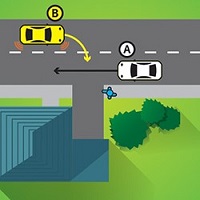
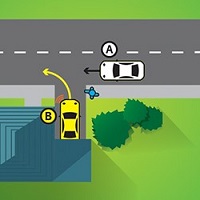
When you are entering or leaving a road from private property or a driveway, you must give way to pedestrians or bicycle and personal mobility device riders on the footpath or road.
You must also give way to any vehicles on the road you are entering. These rules apply whether you are driving forward or in reverse.
In both examples, Vehicle B (yellow) must give way to Vehicle A (white) and the pedestrian about to cross the driveway.
Giving way to pedestrians and bicycle or personal mobility device riders
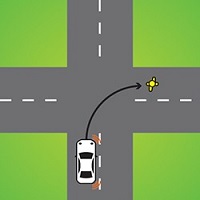
Giving way to pedestrians when turning right
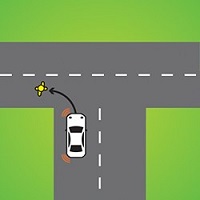
Giving way to pedestrians when turning left
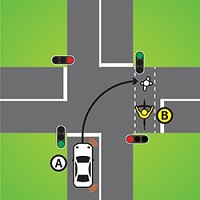
You must give way to pedestrians and bicycle or personal mobility device riders on or entering a road you're turning into or entering. This includes pedestrians or bicycle and personal mobility device riders that are crossing on the green 'walk' signal at an intersection controlled with traffic lights, and you are turning into the road they are crossing.
In both examples, the white vehicle must give way to the yellow pedestrian crossing the road.
Giving way to pedestrian and bicycle rider
In this example, Vehicle A (white) must give way to bicycle rider B (yellow) and the pedestrian crossing the road.
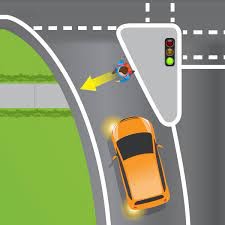
If you are turning left using a slip lane, you must also give way to any pedestrian and bicycle or personal mobility device rider on or entering the slip lane.
Giving way to pedestrians on a slip lane
In this example, Vehicle A (orange) must give way to the pedestrian crossing the road.