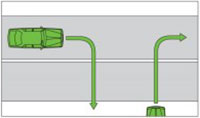
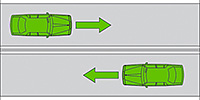
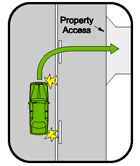
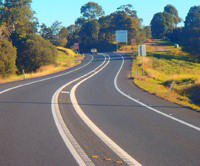
You can cross a single continuous centre line to enter or leave a road, including entering or leaving a property, and to safely pass bicycle riders.
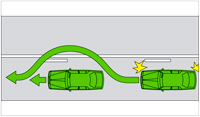
You cannot cross a single continuous centre line to overtake or do a U-turn.
Double continuous centre lines
Crossing a single continuous line left of a broken line
Double continuous centre lines
You must not cross a double continuous centre line except to safely pass a bicycle rider.
Single continuous centre line left of a broken line
You can enter or leave a property or road by crossing a single continuous dividing line to the left of a broken line. You can also cross the line to pass a bicycle rider, provided it is safe to do so.
If you are on the same side of the road as the continuous line you cannot cross the line to overtake or do a U-turn
Video of continuous centre lines
Watch the video to learn more about continuous centre lines.
Duration 00:01:31|Closed captions icon
A lot of people believe you must never cross a continuous centre line.
But that's not the rule.
You certainly can't overtake when there's a continuous centre line and you can't do a U-turn across one.
But you are allowed to cross a continuous centre line if you are entering a road or leaving a road.
Even if there's a broken line on the other side, you're still permitted to cross the continuous centre line if you are entering or leaving a road.
But remember, if there's a double continuous centre line, you're not permitted to cross it at all.
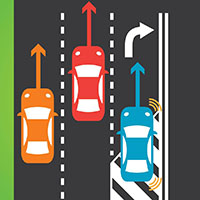
Similar rules apply to painted traffic islands. If the island's surrounded by one continuous line, you can drive on or over it for up to 50 metres in order to enter or leave the road, or to enter a turning lane that begins immediately after the island.
But if the island's surrounded by double continuous lines, or if it separates traffic flowing in the same direction, like where an onramp merges on to a motorway, you must stay off it, unless you need to avoid an obstruction.
Doing it the right way is easy when you know how.
Overtaking across a broken centre line
Broken centre lines
You can overtake across a broken single centre line, or broken centre line to the left of a continuous centre line. You can also turn or do a U-turn across this type of line.
Double broken lines
Double broken centre lines have the same legal standing as a single broken centre line.
Continuous lane lines
You must not cross a continuous line separating 2 lanes unless the lane you are moving to or from is a special purpose lane, such as a transit lane, and the driver is allowed to use the special purpose lane.
Continuous edge lines
Edge lines mark the edge of the road. The area to the left of the edge line is called the shoulder of the road and is not an extra lane for vehicles to travel. Cyclists may travel on the road shoulder.
Motorcyclists—with an open licence for the type of motorcycle they are riding—can also use the road shoulder on roads with a speed limit of 90km/h or over, to pass stationary or slow moving traffic providing they’re not travelling over 30km/h.
You must not cross the continuous white line at the edge of the road unless you are:
overtaking to the left of a vehicle that is turning right or making a U-turn
driving a slow-moving vehicle—to allow other vehicles to overtake or pass.
You can cross a continuous white edge line and travel for up to 100m when you are:
entering or leaving a single lane road
turning at an intersection from a single lane road
stopping at the side of a road—unless signs or markings say not to.
If you are on a multi-lane road you should not cross any edge line before turning.
If the edge line is yellow, stopping and parking is prohibited where the line is marked.
Crossing a painted traffic island with a single continuous line
Painted traffic islands
You can drive on a painted traffic island that is surrounded by a single continuous line for up to 50m to:
enter or leave the road
enter a turning lane that begins immediately after the island.
You can also drive on a painted island to safely overtake a cyclist.
You must not drive on a painted traffic island if the island:
is surrounded by double continuous lines
separates traffic flowing in the same direction—like where an onramp merges onto a motorway.
Stop and give way lines
Stop and give way lines have the same meaning and authority as stop and give way signs.
If you approach a stop line or give way line, where there is no corresponding sign installed, you must obey the road markings as if there was a sign in place.
A road with wide centre lines
Wide centre lines
A wide centre line or strip replaces the existing centre lines with 2 new lines that are up to 1m apart—but the road rules remain the same.
It is illegal to overtake or do a U-turn across a single or double continuous centre line, or a continuous centre line to the left of a broken line.
You can overtake or do a U-turn across a double broken centre line or a continuous centre line with a broken line to the left of it.