Access keys and skip links

Road flooding signage

Water over road and road flooding signs used in Queensland

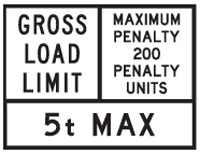
Gross load limit - Maximum penalty 200 penalty units - 5t max sign

This sign is called a Restricted Road Use Notice and is used to restrict use of a road

The restriction is for vehicles with a gross load limit over 5 tonnes.

Penalties apply.

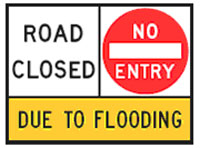
Road closed - Maximum penalty 200 penalty units - Due to flooding sign

This sign is called a Restricted Road Use Notice and is used to restrict use of a road.

The restriction is that the road is temporarily closed. Unless the driver has been granted written approval (under exceptional circumstances) to drive past this sign, it cannot be passed.

Penalties apply.

Road Closed - No entry - Due to flooding sign

This sign means the road is temporarily closed to all traffic. 

Penalties apply.

Road Closed - No entry - Water over road sign

This sign means the road is temporarily closed to all traffic. 

Penalties apply.

Ford sign

The FORD sign is used to warn of a ford, which is a location where water flows over the road except during prolonged dry periods.

Motorists should slow down and be prepared to encounter water over the road.

Floodway sign

The FLOODWAY sign is used to warn of a floodway which is a section of road over which water may flow for short periods.

Motorists should slow down and be prepared to encounter water over the road, especially during and after rain events.

Road subject to flooding sign

The ROAD SUBJECT TO FLOODING, INDICATORS SHOW DEPTH sign is used to advise drivers that the road ahead may be covered by floodwaters.

Motorists should slow down and be prepared to encounter water over the road, especially during and after rain events. Motorists should also look for Depth Indicators.

1 Meter depth indicator sign  4 meters depth indicator sign  6 meters depth indicator sign

DEPTH INDICATORS are used to indicate to drivers the maximum depth of floodwaters across the road. The zero mark on the Depth Indicators is set at the lowest pavement level on the section of road liable to flooding.

While this device will indicate the maximum depth of water it does not indicate how fast the water is moving or if the road surface under water is still intact and trafficable. The water level may also still be rising.

Motorists should generally not attempt to drive through water covering the road.

Road closed sign

The ROAD CLOSED sign is used at temporary road closures. Events that may cause a road to be closed include non-trafficable flood waters, fallen trees or accidents.

Roads are only closed due to safety concerns and drivers must not proceed beyond a road closed sign.

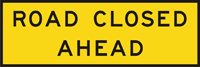
Road closed ahead sign

The ROAD CLOSED AHEAD sign may be used in advance of any temporary road closures.

Drivers should slow down and be prepared to stop at the ROAD CLOSED sign or take an alternative route (if available).

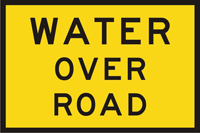
Water over road sign

The WATER OVER ROAD sign is a temporary sign used to indicate that the road ahead is covered by water.

The road at this point is generally still trafficable with care (check DEPTH INDICATORS if present).

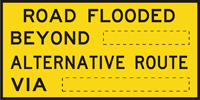
Road flodded beyond

The ROAD FLOODED BEYOND… ALTERNATIVE ROUTE VIA… sign is used where the road ahead beyond a particular town is flooded but there is an available alternate route.

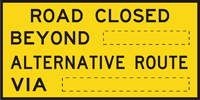
Road closed beyond sign

The ROAD CLOSED BEYOND… ALTERNATIVE ROUTE VIA… sign is used when there is a temporary road closure beyond a particular town and there is an available alternate route.

Road closed sign

The ROAD CLOSED sign (black text on white background) is used to indicate a permanent road closure.

This sign is used for permanent road closures only, temporary road closures are indicated by using the black text on yellow background ROAD CLOSED signs.

Road load limit sign

The ROAD LOAD LIMIT sign may be used to notify drivers (especially heavy vehicle drivers) of the axle weight restrictions that apply to a section of road.

This sign may be used after flood events to prevent damage to roads while the road pavement structure dries out.

Last updated: 23 February 2012