

Bus padding requirements for specified buses
On this page
Purpose of bus padding requirements
Padding requirements are designed to enhance passenger safety by ensuring safety padding is installed on specific hard surfaces within buses, such as handrails, seats, and partitions. These standards vary depending on the bus classification and the date the bus entered service in Queensland.
Regional and local service classification buses
- Regional classification buses: All regional buses must have safety padding, regardless of when they entered service.
- Local classification buses: All local buses that entered service in Queensland on or after 1 January 1997 must have safety padding.
Although padding is not mandatory for open classification buses, owners are encouraged to install padding on unprotected hard surfaces, such as modesty panel handrails, to improve passenger safety.
For more information on service classifications, refer to Service classifications, age, design and life extension of buses on the Operator accreditation vehicle requirements webpage.
School Buses
A school bus means a bus that is used to provide a school service outside, or partly outside, a defined urban area, even if it is used for other purposes at other times.
- All school buses that entered service in Queensland on or after 1 January 1997 must have safety padding.
- From 5 July 2005, safety padding is also required for:
- Light school buses (gross vehicle mass of 5 tonnes or less) that were less than 18 years old as of 5 July 2005.
- Heavy school buses (gross vehicle mass over 5 tonnes) that were less than 23 years old as of 5 July 2005.
To calculate the age of a vehicle, refer to Service classifications, age, design and life extension of buses on the on the Operator accreditation vehicle requirements webpage.
Areas to be padded
Padding must be fitted to any hard surface that could pose a risk to the head of a seated passenger in the event of a frontal collision.
Seats
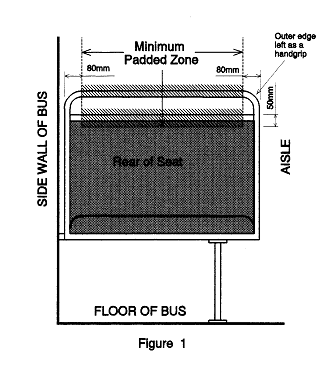
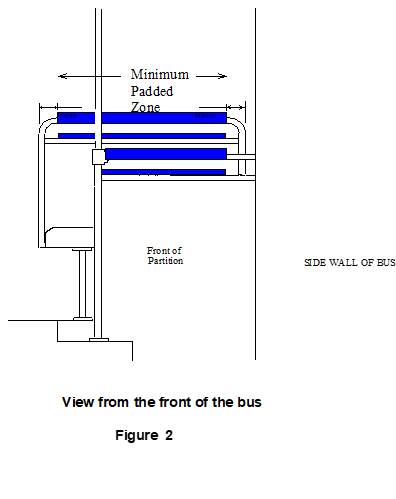
- Seats without exposed hard surfaces in the minimum padded zones (as shown in figures 1 and 2) do not require additional padding.
- High-back coach-style seats or modern metro seats with foam-backed upholstery or moulded foam coverings are exempt from additional padding requirements.
Tops of seats
- If the top face and the rear face of a seat are hard surfaces, both must be padded.
- The padding on the back of the seat must extend at least 50 millimetres down from the top edge.
- The width of the padding across the seat must match the width required for the handrails (see figure 1).
Handrails
- Exposed handrails must be padded at least on the top, rear and front faces to within:
- 80 mm of the outside edge of the seat
- 80 mm of the aisle side of the seat (to allow the handrail to function as a handgrip- see figure)
- For handrails with large diameter bends at the sides, padding may stop at the start of the bend
- However, the padding must not be more than 120 millimetres from the sides.
Partitions
- Partitions directly in front of a seat must be padded along their top edge.
- The top face and the upper 50 millimetres of the rear face of a partition must be padded o cover a zone between two vertical planes 80 millimetres from either side of the seat behind (see figure 2).
- If the aisle side of the partition has a large diameter bend (similar to the seat handrails), the bend does not need padding.
Fittings on the back of a seat or partition
Any fitting on the back of a seat or partition that is outside the minimum padded zone must not pose a risk of injury to a passenger in a frontal collision.
Stanchions
Padding is not required for stanchions, as it could impair the grip of standing passengers further increasing the risk of injury.
Padding materials
Padding must be made of the following materials (or an equivalent material that provides the same level of protection):
- semi-rigid moulded polyurethane
- self-skinning rigid moulded polyurethane
- closed-cell polyethylene foam
- closed-cell EVA foam that:
- is at least 25 millimetres, but not more than 30 millimetres, thick
- has a density of at least 270 kilograms per cubic metre, but not more than 300 kilograms per cubic metre.
Securely fasten the padding to the seat, handrail, or partition. Ensure that fastenings are protected to prevent injury.
Padding standards
The table below summarises the safety padding requirements for different bus locations. To calculate the age of a vehicle, refer to the Service classifications, age, design and life extension of buses on the on the Vehicle requirements for accredited operators webpage.
| Standard required | Safety padding |
|---|---|
| Regional classification | Applicable for all buses |
| Local classification | Applicable for all buses that entered service in Qld on or after 1 January 1997 |
| School bus | Applicable for all school buses that entered service in Qld:
|
References
Transport Operations (Passenger Transport) Regulation 2018
- Section 18H: Requirements for seating.
- Schedule 1AA, Part 8: Detailed padding requirements for buses, including materials, dimensions, and areas to be padded.
Read the full Regulation on the Queensland Legislation website.
- Last updated
- 20 February 2026