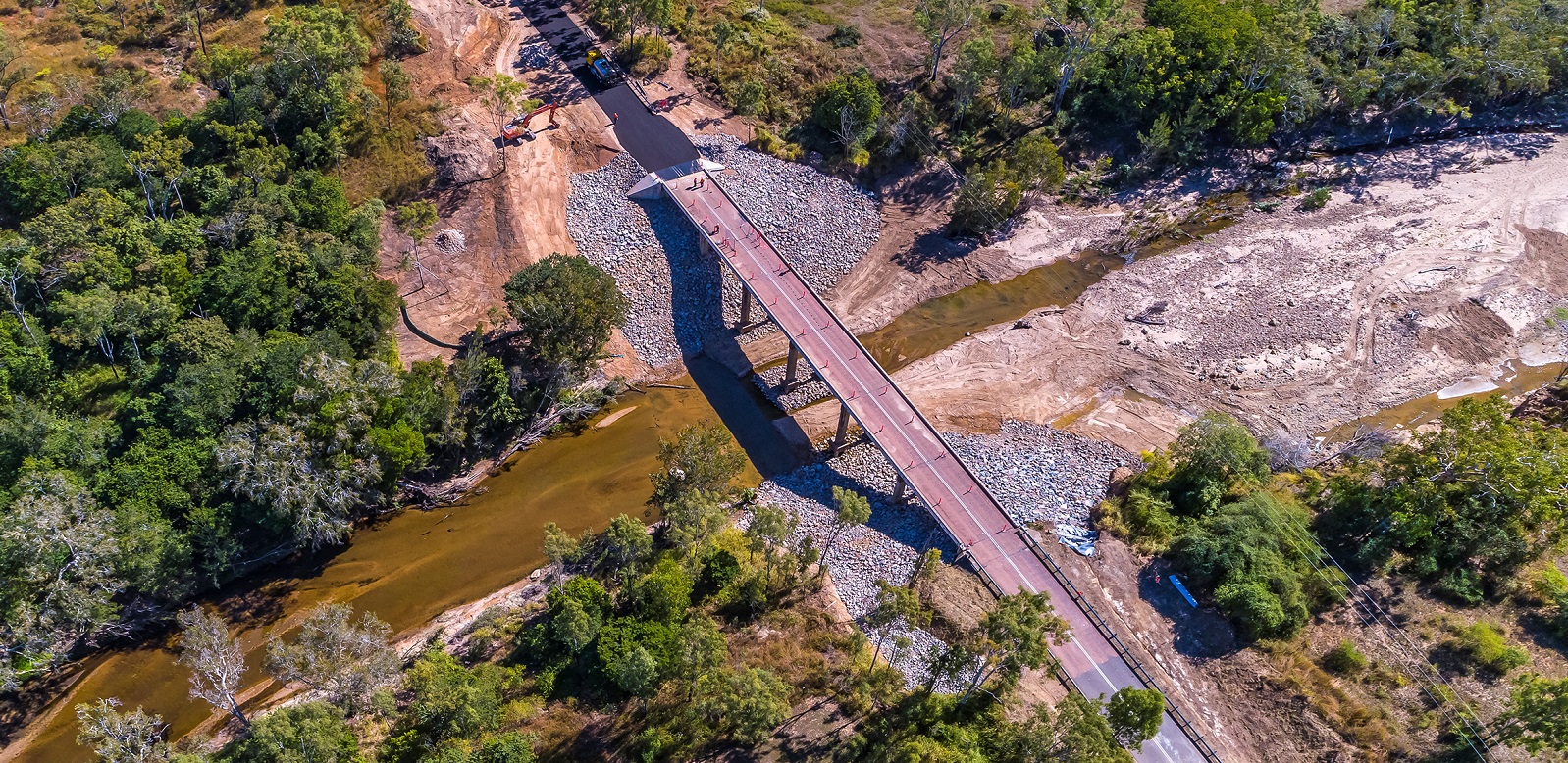
The majority of works will be completed by the end of 2026, subject to weather conditions, site accessibility and contractor availability. Some works may take longer due to the severity of the damage.
Status
Construction
Far North Queensland disaster recovery works
The Queensland Government has made significant progress in repairing roads damaged by Tropical Cyclone Jasper in December 2023 and the North and Far North Tropical Low in February 2025.
The disaster recovery program is well over the half-way mark in restoring roads to their pre-disaster function.
A variety of slope stabilisation techniques are being used to repair upslope and downslope landslips, along with drainage and pavement repairs.
The Queensland Government acknowledges the inconvenience caused by these works but emphasises that such large-scale reconstruction is essential to restore infrastructure and ensure safety.
Geotechnical repairs continue on the following key roads:
Kennedy Highway (Kuranda Range Road)
Captain Cook Highway
Mossman–Mount Molloy Road
Mossman–Daintree Road
Gillies Range Road
Shiptons Flat Road.
Completed Reconstruction Works:
Tully–Mission Beach Road
Bruce Highway, Harvey Creek and Woopen Creek sites
Palmerston Highway
Gillies Range Road, Lake Barrine site
Gulf Developmental Road, Routh Creek Bridge.
Betterment works
Works will be delivered through the 2023–24 Betterment package. The extraordinary disaster assistance is being provided through the jointly funded Commonwealth-State Disaster Recovery Funding Arrangements (DRFA).
Eight state-controlled roads will be improved.
Works are scheduled to be delivered in 2026 and will be completed alongside ongoing reconstruction works.
Collaboration with environmental authorities ensures sensitive environments are managed and monitored.
Disturbance footprints are minimised, and unavoidable vegetation clearing is inspected and supervised.
Rehabilitation programs are being designed for disturbed areas within the Wet Tropics World Heritage Area.
Traffic management
Traffic management measures including reduced speed limits, single-lane closures and traffic lights means the works can be done under traffic and minimise the need for full road closures.
For specific works or the movement of equipment, full road closures may be required for the safety of road workers and road users.
Advance notification to stakeholders will be provided ahead of traffic changes.
Information on the latest traffic conditions will be available by phoning 13 19 40, or by visiting QLDTraffic on www.qldtraffic.qld.gov.au.
Project image
Slope stabilisation solutions explained
The solutions featured here are for example purposes only and not indicative of the specific design required for the pictured damaged slope. Slope stabilisation solutions are based on geotechnical assessments and the needs of each individual site.
Gabion Baskets
Gabion baskets are box-shaped wire of galvanised steel mesh filled with rock or concrete. When stacked, they form a wall to stabilise roads constructed on a slope.
Mesh installation
Constructed from a composite 3D mat structure embedded in a steel wire mesh, this reinforcement provides tensile strength and erosion protection and is used in conjunction with soil nails to reinforce slopes.
Soil nails
Soil nails are steel bars grouted into holes drilled into the slope. Up to 12m long, they are used in combination with shotcrete or mesh to stabilise slopes.
Rockfill embankment
Rockfill embankments rebuild and protect damaged slopes, using sized rocks to slow water flow and prevent erosion.
More than 1400 projects are underway to restore roads across Queensland damaged by floods and bushfires. Communities are being reconnected and regional economic recovery is being supported following damage to the state-controlled road network in 2020–26.
Significant progress has been made in restoring the Kennedy Highway (Kuranda Range Road) to its pre-event function following Tropical Cyclone Jasper in December 2023 and the North and Far North Tropical Low in February 2025.